

What is Transducer?
A transducer is any device which may converts one form of energy into another. The transducer includes the sensors and actuating systems.
For example a ‘Thermocouple’ is an example of transducer which can converts temperature changes into electrical voltage.
Sensors
By definition a sensor is a device that can converts a physical phenomenon or physical energy into an electrical signal or electrical energy by definition. Therefore a sensor can be viewed as a part of the interface between the physical world and the world of electrical devices, such as computer system.

For example, The photo-diode and photo-transistor are some example of sensors which may converts incoming brightness into electrical current.

Thus, the photo-diodes current is directly proportional to light intensity falling onto the PN-junction. A photo-transistor, on the other hand, uses the level of light it detects to determine how much current can pass through the circuit. So, if the sensor is in a dark room, it only lets a small amount of current through. If it detects a bright light, it lets a larger amount of current through.

Smart Sensor:
A smart sensor is a device which collects environmental data and performs some functions by using built-in resources and does some computation process before passing the collected data to other devices such as main processor
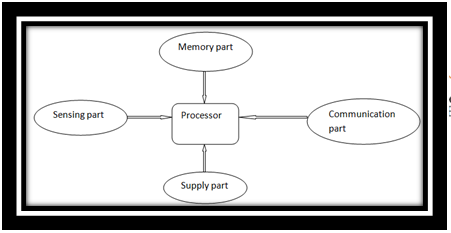
As additional to an ordinary sensor, a smart sensor contains a sensing element, processor, memory and communication element, transducer, amplifier, excitation control,filters and compensation. A smart sensor includes also some intelligent capabilities over a conventional sensor. These include wireless communication and are integrated on-board micro-controller.
Therefore , a smart sensor has additional capability of processing the collect data based on the desired output requirement over the simple sensor. It can be used for analog to digital conversion or digital processing and it is characterized by a small size ,low power consumption and the high performance.
Application: Nowadays everyone is so busy by struggling to survive, sometimes someone could even forget to take care of his health. Therefore with the development of Internet of Things (IoT) , many intelligent and medical sensors have constructed for analyzing the patient activity and automatically predict an incoming disease before the patient feels sick.
Sensors Classification:

Sensors classification based on the power source :
- Active sensors (RTD)
- Passive Sensors (Thermocouple)
Sensors classification based on application areas:
- Temperature sensors
- Position sensors
- Displacement sensors
- Distance Sensors
- Speed Sensors
- Humidity Sensors
- PH sensors
- Light Sensors
- Weight Sensor
- Pressure sensors
Sensors classification based on working principle
- Electro-mechanical sensor (Bimetallic switch)
- Electronic sensor (Infrared)
- Resistive Sensor (RTD, Thermistor)
Sensors classification based on output signal type:
- Analog Sensors (DHT22)
- Digital Sensors (LM35)
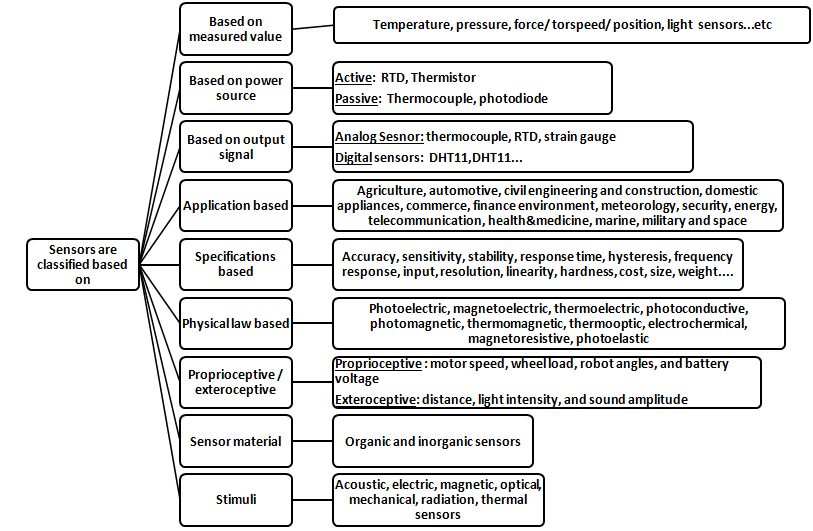
Sensor classification Map:
REFERENCES
[1]. https://www.engineersgarage.com/articles/sensors
[2]. https://www.electronicshub.org/different-types-sensors/
[3]. https://www.finoit.com/blog/top-15-sensor-types-used-iot/
 IoTnetBlog.com